

The Anxiety Trap: Is GABA a Miracle or a Marketing Myth?

Today, we're diving deep into something that affects so many of us: Anxiety.
I'm talking about that nervous feeling, the knot in your stomach, or when your brain just won't shut off, no matter how tired you are. For many of you (and me too, ever since I was a little kid!), it’s not just a "bad day." It's a constant battle.
When anxiety gets really tough, we often look for help. Maybe it's a doctor who gives you a prescription like Xanax, or maybe it’s a "natural" supplement you find at the health food store.
If you’ve ever taken a GABA supplement for anxiety, hoping it would calm your racing thoughts… you’re not alone.
But what if I told you it might not even reach your brain?
Many ads say it's like the "brakes for your brain." People trying to stop using medications like Xanax are often told that GABA supplements can help them calm down.
But does it actually work? Or is it just another expensive bottle of chemicals hiding behind a healthy-sounding name? Let's peel back the marketing and see what the science really says.
To watch or listen to this blog post instead, click here.
Here's what you'll learn in this article:
- What is GABA and how does it affect anxiety?
- How GABA supplements are actually made
- Can GABA supplements cross the Blood-Brain Barrier?
- Why GABA may not work (what the science says)
- GABA vs Benzodiazenines:The tapering trap
- Why some people think GABA works
- Final verdict: Is GABA worth it?
- Better natural ways to support anxiety relief
What Is GABA and How Does It Affect Anxiety?
First, let's understand what we're talking about.
Your brain has tiny messengers called neurotransmitters. Think of them like little chemical texts that tell your brain what to do.
- Glutamate is like the "gas pedal" – it gets your brain excited and active.
- GABA (which stands for Gamma-Aminobutyric Acid) is like the "brakes" – it tells your nervous system to chill out.
When your brain makes its own GABA, it helps you relax, lowers your heart rate, and calms those racing thoughts.
But here's the BIG secret: There's a huge difference between the GABA your brain makes and the GABA powder you buy in a bottle.
The companies selling these supplements want you to think they're the same. They're not! One is a natural signal created inside your body's cells; the other is a product made in a factory.
How GABA Supplements Are Actually Made

It may be marketed as ‘natural,’ but most GABA is made in a lab.
If you imagine GABA supplements are just "ground-up plants," you might be surprised.
Most GABA sold today isn't "natural" in the way an apple or a carrot is natural. It's made in a lab using either industrial fermentation (like brewing beer, but for chemicals) or chemical synthesis (creating it from other chemicals).
The "Natural-Sounding" Fermentation Way
Most GABA that claims to be "natural" is made using a type of bacteria called Lactobacillus hilgardii. This is the same kind of bacteria used to make kimchi, which sounds pretty natural, right?
But to turn it into a concentrated powder, manufacturers use:
- Nutrient Soups: Often made from things like soy or dairy leftovers.
- Solvents: Special liquids (chemicals) used to pull the GABA out of the bacteria "sludge."
- Acids: Used to get the mix just right.
The Purely Chemical Way
Then there's the totally chemical version.
This involves starting with chemicals like phthalimide (which is used in plastics and dyes) and mixing it with other strong chemicals and solvents.
Think about it:
Your body is designed to make its own GABA from a basic building block called Glutamine. When we try to force it by swallowing a lab-made version, we're ignoring the fact that our body didn't ask for a chemical import; it asked for healthy ingredients to make its own.
Can GABA Supplements Cross the Blood-Brain Barrier?
Now, for the million-dollar question: If you swallow a GABA supplement, does it actually get into your brain where it needs to do its job?
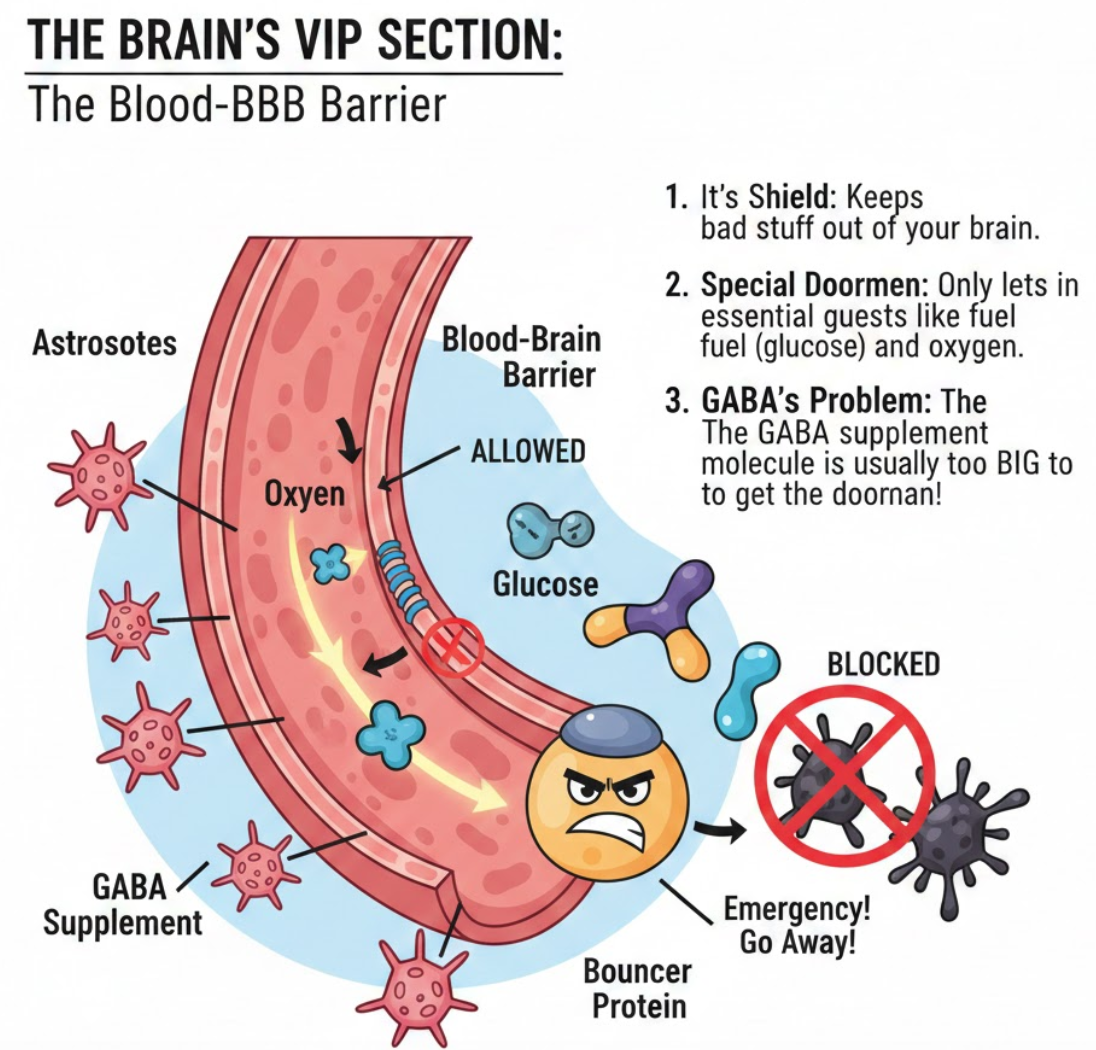
Imagine your brain is a super-exclusive club with a very tough bouncer at the door. That bouncer is called the Blood-Brain Barrier (BBB). Its job is to keep bad stuff and "uninvited" chemicals out of your sensitive brain.
Why GABA May Not Work (What the Science Says)
The Science: Most studies show that the GABA molecule from supplements is usually too big and shaped incorrectly to get past that bouncer and into your brain.
A big review in 2015 published in Frontiers in Psychology looked at many different studies.1
Their conclusion? While some people feel better (this is called the placebo effect – meaning your belief makes you feel better), there's very little proof that GABA supplements actually get into the human brain in any real amount.
If it can't get into the brain, it can't press the "brakes" on your anxiety.
GABA vs Benzodiazepines: The Tapering Trap
This part is really important.
Many people try GABA because they want to stop taking medications like Benzodiazepines (like Xanax or Ativan).
When you take a benzo, it doesn't just give you GABA; it forces the GABA "doorways" in your brain to stay open. Over time, your brain says, "Whoa, too much GABA signal!" and it actually starts to close down its own doorways to protect itself. This is called tolerance.
So, people will increase their dose. Or take a “rescue dose” in the middle of the night when they wake up wired. I know this because I did it once. I never wanted to take a benzo, but after 12 days, when I didn’t sleep at all, I got some in desperation.
Then, although it’s not addictive, it’s habit-forming because you have a fear of not sleeping the next night. And then the next.
When you stop taking the drug, you're left with:
- No drug.
- Brain "doorways" that are damaged or have shrunk.
- Your own natural GABA production has taken a vacation.
The Marketing Lie: "Just take a GABA supplement to fill the gap!"
The Truth: If the GABA supplement can't get past your brain's bouncer, it's not going to fix those damaged doorways.
For many people (including me), taking GABA did nothing for anxiety or sleep. It's like trying to put gas in a car with a locked gas cap. It won’t get in. And it’s at least a little bit toxic.
Some people feel valerian root or kava, which are at least natural herbs, help them. I haven’t ever noticed any calming or sleepy effect. And L-Theanine is another lab-made synthetic product that isn’t what your body makes on its own.
Why Some People Think GABA Works
Your own natural GABA production does work. And if the molecularly similar product doesn't cross the blood-brain barrier, why do some people swear by GABA supplements?
First of all, I’ve never met anyone who does. But just in case someone says it’s useful, I have two main theories:
- The Gut-Brain Link: You actually have GABA "doorways" in your gut. Sometimes, calming your "second brain" in your stomach can send a small signal that slightly relaxes your main brain.
- The Placebo Effect: When we're desperate for help and spend money on something, we really want it to work. Our minds are incredibly powerful, and sometimes just believing something will help can make us feel better. Lots of studies on placebos show that 60 to 65 percent of people say the placebo helped them. That’s really interesting, considering the number should be 0!
But if you have chronic, lifelong anxiety, a "maybe it helps a little" isn't good enough. You deserve something better than a lab-made chemical that might not even reach its target.
Final Verdict: Is GABA Worth It?

Stop falling for the supplement industry's "quick fixes." Your anxiety is real, your struggles are real, and the solution needs to be real, too.
We've been told that for every "bad" feeling, there's a "good" pill or supplement. But true healing from anxiety usually doesn't come from a lab-made chemical.
It comes from:
- Healing your gut: So your body can make its own natural brain messengers.
- Lowering inflammation: This helps keep your blood-brain barrier strong.
- Getting enough key nutrients, like magnesium and vitamin B6, which help your brain do its job naturally.
Stop falling for the supplement industry's "quick fixes." Your anxiety is real, your struggles are real, and the solution needs to be real, too.
Better Natural Ways to Support Anxiety Relief
Clearing the metabolites of the benzo drug happened fast for me, as I was doing the GreenSmoothieGirl Detox at the time.
The two just accidentally coincided – getting rid of the second “rescue” dose in the middle of the night, and beginning a taper – and the symptoms I was told to expect for 10 days happened only for 1 day.
In fact, I didn’t have the full-blown panic attack I’d read about, shaking, or actual seizures – just extreme, heightened anxiety for a full day. Better 1 day than 10! And, I’m glad it’s over, and I’m never going back to that drug–not worth it, for what came afterward. And what I learned its effects are over time.
Also, as I quit the second “rescue dose,” as the benzo drug became less and less effective, and tapered down the first dose, I doubled up on my Ultimate Minerals dose. It’s the magnesium I was going for, which is calming and well-documented to help you go to sleep – and I no longer will take the magnesium pills, now that I know they’re ground-up rocks, chalk, or shells.
I know Ultimate Minerals is the “whole food” of supplements, no chemistry involved, and it’s got all the macro minerals and all the trace minerals to complement the magnesium, from the same place the vegetable plant tries to get it – ancient plant deposits in the soil.
Some links may compensate this small business if they’re one of our products or an affiliate relationship.
Read Next: The Most Useful Anti-Anxiety Hack I’ve Ever Found
Read Next: How To Fight Depression and Anxiety: 12 Nutrition Strategies
 Robyn Openshaw, MSW, is the bestselling author of The Green Smoothies Diet, 12 Steps to Whole Foods, and 2017’s #1 Amazon Bestseller and USA Today Bestseller, Vibe. Learn more about how to make the journey painless, from the nutrient-scarce Standard American Diet, to a whole-foods diet, in her free video masterclass 12 Steps to Whole Foods.
Disclosure: This post may contain affiliate links that help support the GSG mission without costing you extra. I recommend only companies and products that I use myself.
Frequently Asked Questions About GABA Supplements for Anxiety
Does GABA help with anxiety?
GABA is a calming neurotransmitter your body naturally produces, and it plays an important role in reducing anxiety.
However, most research suggests that GABA supplements taken by mouth do not effectively reach the brain, which means they may not provide the calming effect people expect. Some individuals report feeling better, but this may be due to the placebo effect or indirect effects through the gut.
Can GABA cross the blood-brain barrier?
The blood-brain barrier is a protective filter that controls what enters the brain.
Most studies indicate that GABA supplements have limited ability to cross this barrier, meaning very little (if any) reaches the brain where it would need to act to reduce anxiety.
Are GABA supplements natural?
Despite being marketed as “natural,” most GABA supplements are produced in laboratories, often using fermentation or chemical synthesis.
This is very different from the GABA your body naturally produces using nutrients like vitamin B6 and glutamine.
What are better natural alternatives to GABA supplements for anxiety?
Instead of relying on GABA supplements, focus on supporting your body’s ability to regulate anxiety naturally:
- Magnesium-rich foods or high-quality mineral support
- Vitamin B6 and whole-food nutrition
- Gut health support
- Reducing inflammation through a clean diet
- Stress regulation practices like breathwork and mindfulness
These approaches address the root causes of anxiety rather than trying to override the system.
Resources
- Boonstra, E., de Kleijn, R., Colzato, L. S., et al. (2015). Neurotransmitters as food supplements: the effects of GABA on brain and behavior. Frontiers in Psychology. https://doi.org/10.3389/fpsyg.2015.01520
Image Notes
- Greens photo by Pille R. Priske on Unsplash
Posted in: Emotional Health, Health Concerns, High-Vibe Living, Holistic Care, Mind/Body Connection, Natural Remedies, Stress Management, Whole Food










Luckily for me and thus far I haven't experienced constant anxiety. In comparison to me. I consider you the doctor Robyn. Besides everything you've mentioned in this article. I would consider nutritional support for hormonal balancing and nervous system support. I'm sure you've touched on this, or other worthwhile considerations in the other two articles you have linked above. Thank you for always reminding us of the importance of good gut health and detox.
Forgot to mention that I'm getting ready to read your other two articles linked above.