

Is Ketosis Overrated? The Real Magic Happens with Autophagy
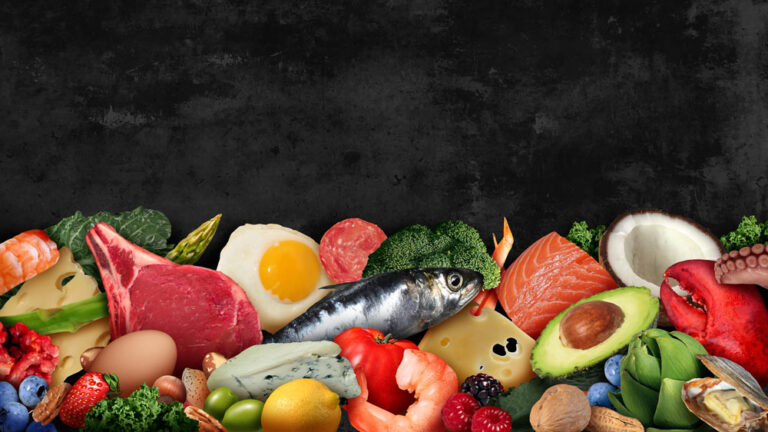
Ketosis is everywhere – but what if it’s distracting you from a far more powerful health process?
Today, we’re going to talk about a massive "health" trend that has been taking up all the oxygen in the room for the past decade.
If you’ve spent five minutes on social media in recent years, you’ve heard of it: Ketosis.
People are obsessed with it. They’re peeing on strips, eating sticks of butter, drinking petroleum-based “ketone” drinks, and talking about "macros" as if nutrition is just a math problem of protein, fat, and carbs.
But I’m going to be honest with you:
I think ketosis is largely a national obsession created by marketers. It is a fad that is far less important and less interesting than another phenomenon that happens when we fast, or give our bodies very little to eat for a period of time.
While everyone is distracted by burning fat for fuel, they’re missing out on a process that is infinitely more powerful and vital for your long-term health. Even if it’s harder for marketers to make money on it, you need to know about it. That process is called autophagy.
To watch or listen to this blog post instead, click here.
Here's what you'll read in this article:
- The myth of the 3-day meal
- What is autophagy? (the body's cellular cleanup system)
- The science of rejuvenation
- How to trigger autophagy naturally
- Autophagy vs. ketosis: what's the difference?
- 4 researchers studying the health effects of fasting and autophagy
- The bottom line: autophagy vs ketosis
The Myth of the Three-Meal Day

For 99% of human history, our ancestors were lucky to get two meals a day.
Before we dive into what autophagy is, we have to debunk a huge myth.
Most of us grew up being told that "breakfast is the most important meal of the day" and that we need three "square meals" to stay healthy.
The truth? That’s a total modern convenience that sold a lot of breakfast cereal. For 99% of human history, we didn't have refrigerators, Uber Eats, or even grocery stores. Our ancestors were lucky to get two meals a day.
In fact, most humans on Earth right now are lucky to get two meals a day. Interestingly, poorer populations – unless their water has been polluted by industrial countries – have a fraction of the rates of cancer and other “diseases of affluence” that Americans do. We think we’re going hungry if we don’t eat at least three times every day. It’s actually funny when people call not eating between dinner and breakfast “intermittent fasting.” That used to just be called "sleeping!" Or “the time between dinner and breakfast.”
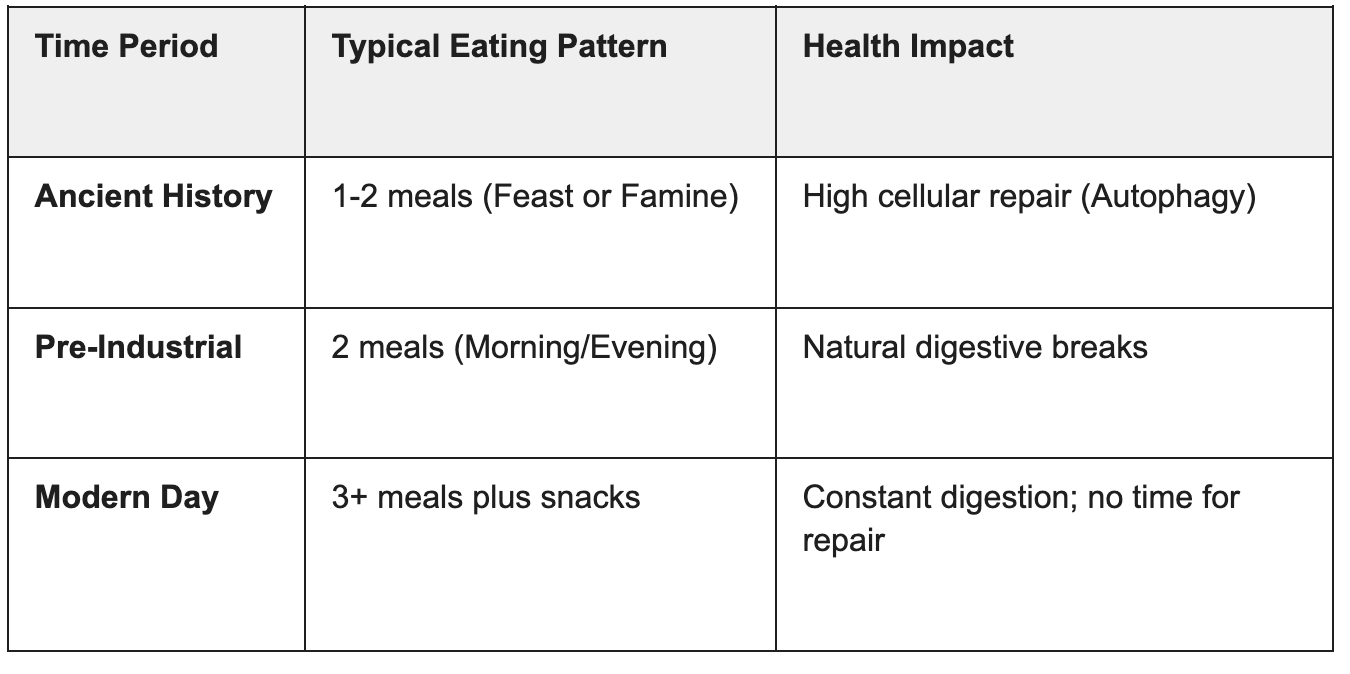
Our bodies aren't designed to be constantly digesting. When our system is always "on," it never gets a break to do the deep cleaning it desperately needs.
What Is Autophagy? (The Body’s Cellular Cleanup System)
So, what happens when we finally stop eating for a bit? That’s when autophagy kicks in.
The word "autophagy" comes from the Greek words auto (self) and phagy (eating). It literally means "self-eating." Now, that sounds a little scary, but it’s actually the most brilliant "housekeeping" system ever designed.
Think of your body like a high-end restaurant. If the kitchen is cooking 24/7, the chefs never have time to scrub the floors or deep-clean the ovens. Eventually, the kitchen gets greasy and dangerous.
Autophagy is the "night crew" that comes in when the kitchen (your metabolism) finally shuts down. It identifies old, broken, and "aberrant" cells and clears them out.
Dr. Valter Longo, author of The Longevity Diet, uses a great metaphor: Think of the body like a train that burns wood for fuel. If your train is going to run out of wood, what would you do? You might chop up an old, broken wooden seat in the cabin to keep the train moving to the station. The body does the same thing: it goes after broken parts when it doesn't have constant food coming in.
What are "Aberrant" Cells?
"Aberrant" means cells that have gone rogue or stopped working properly.
This includes:
- Misfolded proteins: "Clumps" in your brain and body that can lead to disease.
- Damaged mitochondria: The "power plants" of your cells. When they’re broken, you feel exhausted.
- Malignant/Pre-cancerous cells: Cells starting to grow in ways they shouldn’t.
- Viruses and bacteria: Autophagy can actually "eat" and recycle invading germs.
Instead of letting this cellular "trash" pile up and cause inflammation, autophagy breaks these parts down into raw materials to build new, healthy cells.
The Science of Rejuvenation
Dr. Longo’s research shows that we can "program" our cells through what he calls a Fasting-Mimicking Diet (FMD).
His findings are a game-changer:
- Stem Cell Activation: Once a fast is broken (the refeeding phase), the body triggers a surge in stem cells to rebuild your systems with brand-new cells. The best stem cells are the ones your own body makes for you!
- Biological Age Reduction: A 2024 study showed that just 3 cycles of a 5-day modified fast could reduce a person's biological age by an average of 2.5 years.
- Cancer Protection: In his 2025 book Fasting Cancer, Longo explains that healthy cells go into a "shielded" mode during a fast, while "greedy" cancer cells become more vulnerable because they can't stop trying to grow.
How to Trigger Autophagy Naturally
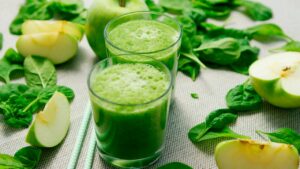
When you follow the GreenSmoothieGirl Detox, we are essentially "tricking" the body into autophagy.
If you want to trigger this deep-cleaning process, you have two main options:
1 — The "Hard Way": Water Fasting
This means going without food for 24, 48, or even 72 hours.
I’ve fasted for up to 12 days before, and let’s be real: it’s miserable. It’s hard to work or take care of kids when you’re starving and lightheaded.
Related: I Tried Water Fasting Without Food | Here’s What I Learned
2 — The "Smart Way": The GreenSmoothieGirl Detox
This is why I’m so passionate about what we do. Dr. Longo found that if people ate clean, plant-based whole foods, they could eat 600 to 800 calories a day and still get the benefits of fasting.
When you follow the GreenSmoothieGirl Detox, we use specific, nutrient-dense foods that keep your energy up while keeping your insulin low.
We are essentially "tricking" the body into autophagy. You get the cellular benefits – the anti-aging, the brain clarity, the disease prevention – without the misery of total starvation.
Autophagy vs Ketosis: What’s the Difference?
Ketosis is just about what fuel you’re burning. It’s like changing the type of gas in your car. It’s fine, but it doesn't fix a broken engine. Autophagy is about fixing the engine.
It’s about making sure you aren't carrying around toxic "junk" that makes you feel old and sick. We need to get back to our roots – not by starving, but by giving our bodies the "downward" time they evolved to have.
4 Researchers Studying the Health Effects of Fasting and Autophagy
If you have a minute, let me highlight four more researchers whose contributions to studying the health effects of fasting and autophagy are pretty interesting.
1 — Dr. Yoshinori Ohsumi: The "Father of Autophagy"
If Dr. Longo is the "architect" of fasting diets, Dr. Ohsumi is the man who discovered the "machinery" inside the cell. He won the 2016 Nobel Prize for his work.
- The Discovery: Using baker’s yeast, he identified the specific genes (ATG genes) that control how cells recycle their own components.
- The Key Insight: He proved that autophagy isn't just a "garbage disposal" but a sophisticated recycling plant. When the cell is stressed (by fasting), it breaks down old proteins into amino acids to build new, essential structures.
- Podcast Takeaway: Without Ohsumi’s work, we wouldn’t have the scientific proof that fasting actually "cleans" our cells at a molecular level.
2 — Dr. Satchin Panda: The "Circadian Master"
Dr. Panda, a professor at the Salk Institute, moved the conversation from what we eat to when we eat. He coined the term Time-Restricted Eating (TRE).
- The Discovery: He found that nearly every organ in the body has its own "clock." When we eat late at night, we "clash" with these clocks, leading to metabolic "jet lag."
- The Key Insight: His research showed that mice (and humans) who eat within an 8–10 hour window are significantly leaner and have better liver health than those who eat the same number of calories spread throughout the day.
- Takeaway: Autophagy isn't just about length of time; it's about alignment. Fasting overnight for 12–16 hours supports the natural circadian rhythm of cellular repair.
3 — Dr. Mark Mattson: The "Brain Health Pioneer"
A former Chief of the Laboratory of Neurosciences at the National Institute on Aging, Dr. Mattson is the leading voice on how fasting protects the nervous system.
- The Discovery: He pioneered research into how fasting triggers BDNF (Brain-Derived Neurotrophic Factor) – essentially "Miracle-Gro" for the brain.
- The Key Insight: Mattson explains that fasting is a "metabolic challenge" that makes neurons stronger. Just as lifting weights tears and rebuilds muscle, intermittent fasting (like the 5:2 method) stresses neurons in a way that protects them from Alzheimer's and Parkinson's.
- Takeaway: Fasting isn't just for weight loss or "cleaning" cells; it's a cognitive enhancer that builds "brain resilience."
4 — And One More Great “Fasting” Practitioner: Dr. Jason Fung
While more of a clinical practitioner than a laboratory researcher, Dr. Jason Fung is vital for the metabolic/insulin angle.
His work in The Obesity Code popularized the idea that fasting is the most effective tool for reversing Type 2 Diabetes by lowering insulin levels and allowing the body to access stored fat.
These various researchers built on each other’s work. Autophagy is the unsung hero that may hold many keys to rebooting our health, longevity, and prevention of many diseases.
I hope this was useful for you, and that you give autophagy more of the brain space that ketosis has been getting!
The Bottom Line: Autophagy vs Ketosis
If you strip away the hype, the difference between autophagy and ketosis is actually pretty simple:
Ketosis is about fuel. Autophagy is about repair.
Ketosis happens when your body switches from burning glucose to burning fat for energy.
That can be useful, especially for stabilizing blood sugar or increasing fat loss, but it doesn’t necessarily address what’s happening inside your cells.
Autophagy, on the other hand, is your body’s built-in clean-up and renewal system.
It breaks down damaged proteins, dysfunctional cells, and cellular debris – and recycles them into new, healthier components. This is the process most closely linked to longevity, disease prevention, and true cellular rejuvenation.
Here’s the key distinction:
- You can be in ketosis without significant autophagy (for example, eating high-fat foods all day long).
- But you generally can’t activate meaningful autophagy without some level of caloric restriction or fasting.
That’s why focusing only on ketosis can miss the bigger picture.
The takeaway?
Ketosis might change what your body burns, but autophagy changes how your body rebuilds.
And in the long run, how you rebuild matters a whole lot more than what fuel you’re running on.
Read Next: Trendy Longevity and Detox Supplements: Are We Chasing Health or Hype?
Some links may compensate this small business if they’re one of our products or an affiliate relationship.
 Robyn Openshaw, MSW, is the bestselling author of The Green Smoothies Diet, 12 Steps to Whole Foods, and 2017’s #1 Amazon Bestseller and USA Today Bestseller, Vibe. Learn more about how to make the journey painless, from the nutrient-scarce Standard American Diet, to a whole-foods diet, in her free video masterclass 12 Steps to Whole Foods.
Disclosure: This post may contain affiliate links that help support the GSG mission without costing you extra. I recommend only companies and products that I use myself.
Frequently Asked Questions About Autophagy
Does ketosis trigger autophagy?
Not necessarily. While ketosis and autophagy can happen at the same time, they are not the same thing.
Ketosis is simply a shift in fuel (burning fat instead of glucose), while autophagy is a cellular repair process.
You can be in ketosis while still eating frequently, which may limit autophagy. In general, fasting or caloric restriction is the more reliable way to activate deeper autophagy.
Posted in: Detox, Fasting, Health Concerns, Healthy Weight, Holistic Care, Natural Remedies, Preventive Care










No comments found, but you can be our first!