Do We Really Need to Drink 8 Glasses a Day? The Great Hydration Myth
The idea that everyone must drink eight glasses of water a day has been repeated for decades – but modern research suggests this hydration rule may be more myth than science.
Sometimes we just assume certain things are true because we’ve heard them so many times from marketers.
Today, I want to dig into where the most basic health advice you can imagine came from. Drink 8 glasses of water a day!
If you’d rather listen or watch, check out my video or podcast!
What you'll find in this article:
- Do you need to drink 8 glasses of water?
- Where the 8 glasses a day rule came from
- Can you trust thirst to guide hydration?
- How much water comes from food?
- Is clear urine really healthier?
- Risks of drinking too much water
- A smarter way to stay hydrated naturally
- This is how I drink water
Do You Need to Drink 8 Glasses of Water?
Half a gallon, based on your weight, but that’s an average.
You hear it from doctors, dieticians, and even on the back of cereal boxes.
But what if I told you this sacred rule is less based on hard science and more on a single, misquoted recommendation from over 80 years ago?
And what if, like me, you felt better when you decided to quit the forced water chugging? I quit drinking water all day, years ago.
And it’s not that I don’t think you’re made of water. You are. It’s not that you don’t lose water and need to replace it. I do.
When I was a nursing mother, another older mom told me, “Every time you walk past the sink, drink some water.” And I did, and figured that’s why I was a pro at making breast milk. Maybe nursing moms need to be careful to stay hydrated.
But what I’ve learned from studying this whenever I can, especially as AI came out, and can survey the whole of PubMed in a hot minute – is that you get a lot from fruits and vegetables that is infinitely more usable by the body.
And that overdrinking water has negative effects, too. Also, 8 glasses a day is unsupported by any research.
Let’s dig deep into the origins of the "8 glasses of 8 oz" rule and confront the counter-narratives about true hydration. I used to chase 8 glasses of water a day, too.
Where the “8 Glasses a Day” Rule Came From
The idea to drink eight glasses of water didn't come from a study showing we were dangerously dehydrated; it came from a nutritional guideline that was never intended to be about drinking plain water exclusively.
When you try to trace this rule back to a definitive, modern, evidence-based study, the trail goes cold.
Many experts and researchers point to a single, often-cited document as the likely, yet misunderstood, source:
- The 1945 Food and Nutrition Board Recommendation: The National Research Council's Food and Nutrition Board stated in 1945: "A suitable allowance of water for adults is 2.5 liters daily in most instances. An ordinary standard is 1 milliliter for each calorie of food. Here’s the rub: most of this is found in foods, and you’re told that doesn’t “count.”
The critical misquote is, "Most of this is contained in prepared foods," largely ignored in the public interpretation.
The media and public seized on the 2.5 liters (about 8 glasses). And omitted the fact that a significant portion of that fluid intake comes from the food we eat.
When I play sports a few times a week, I often see teammates carrying half-gallon Hydroflasks with markings on them to measure their half-gallon goal.
In short: The idea to drink eight glasses of water didn't come from a study showing we were dangerously dehydrated; it came from a nutritional guideline that was never intended to be about drinking plain water exclusively.
Some people say the 8 glasses of water a day narrative corresponded with when they began medicating the water with the chemical fluoride. And the “drink your fluoride” narrative began, before I was born. I can’t prove or disprove this, but in case you haven’t heard:
The current Trump and HHS administration just announced that, as of Jan 20, they will be advising municipalities and water supply facilities nationwide that they should stop fluoridating the water. I don’t know about you, but I have been hoping for this day for decades!
[Related: Is Fluoride Good for Your Teeth? Know the Science & the Risks]
Can You Trust Thirst to Guide Hydration?
The biggest counter-narrative to the 8x8 rule is that it ignores the body's own, incredibly accurate, hydration regulator: thirst.
Thirst: Your Body’s Internal Barometer
One narrative, especially from a book that went viral, by Dr. Batmanghelidj or “Dr. B,” Your Body’s Many Cries for Water, was that by the time you’re thirsty, your dehydration is extreme. I was heavily influenced by this book in 1992, when it came out.
For a healthy adult, the feeling of thirst is your body’s sophisticated mechanism for maintaining osmotic balance – the correct concentration of salts and water in your blood.
- When your blood volume drops or the salt concentration (osmolality) rises, your brain detects this change and triggers a powerful urge to drink. This mechanism is so reliable that doctors and nephrologists often refer to it as "nature's guide."
Dehydration is absolutely possible and can contribute to kidney stones or heat stroke. But science since 1992 shows it is not the universal cause of broad disease categories, like Dr. B’s book alleged.
I have seen over and over again that the bestselling books in health and wellness are the ones that laser in on one food, one habit, one substance – promoting it as solving dozens or more health problems. People tend to really like this “magic bullet” thinking, and the publishing, supplement, and drug industries noticed a long time ago!
How Much Water Comes From Food?

I quit drinking water, beyond a couple of glasses, because I realized I was getting a lot of better water from whole, raw foods.
I quit drinking plain water beyond a couple of glasses a day at most, a few years ago because I felt like there wasn't strong evidence to support the “daily chugging” ritual.
I realized I was getting a lot of better water from whole, raw foods.
I also thought the amount of times a day I had to pee, if I drank 8 glasses – was fairly ridiculous. This is what started my inquiry.
When your blood sugar is normal, and you’ve ruled out diabetes, and you have to go to the bathroom every 30-60 minutes, and you never, ever get thirsty – are you overdoing it?
What I learned is that especially fruit is mostly water – and I eat a lot of fruit.
Green smoothies. Vegetables. We juice (cucumbers, celery, limes, and ginger) a few times a week. Adding much more water, for us, is overkill.
I get SO MUCH WATER from my diet.
When you eat a large salad, a bowl of soup, or a piece of fruit, you are not just consuming nutrients; you are taking in a substantial amount of fluid that counts toward your daily needs.
I probably drink 1 to 2 glasses of water a day (with our Ultimate Minerals added) for many years now. If I ever felt thirsty, I would absolutely drink water! With what my diet provides, even playing pickleball in the afternoon in Florida summers, I just don’t get thirsty.
(You might. People eating a lot of meat, salty foods, or a diet low in fruits and vegetables are probably more likely to get thirsty.)
For many years before that, I thought I was trying to hit a quota.
Is Clear Urine Really Healthier?
Perhaps the most common false narrative pushed by the hydration police is the obsession with clear urine.
The myth is that if your urine is not clear, you are dangerously dehydrated.
The truth is that urine is naturally yellow because it contains urobilin, a waste product from the breakdown of old red blood cells. Healthy urine should range from a pale straw-yellow to a light amber.
- Clear Urine: While often touted as the "gold standard" of hydration, persistently clear urine actually indicates over-hydration. It means your kidneys are working overtime to flush out excess water and have not had a chance to properly concentrate the waste products.
- Darker Yellow or Amber Urine: This usually indicates your body needs water, and thirst is a much better, earlier warning sign.
Risks of Drinking Too Much Water
The hydration campaign often fails to warn people about the danger on the other side of the scale: over-hydration.
Drinking excessive amounts of water in a short period can lead to a potentially fatal condition called hyponatremia, or water intoxication. Obviously, this is very rare, but I wonder if milder effects of drinking too much water just aren’t being studied.
- The Science of Hyponatremia shows that when you drink too much water, you rapidly dilute the sodium concentration in your bloodstream.
- Due to osmosis, the water moves from the lower-concentration blood into the higher-concentration cells, causing the cells to swell.
- When this swelling happens in the brain cells, it can cause seizures, coma, and even death. This is a critical problem for endurance athletes or individuals who force themselves to rapidly consume gallons of water, as the sodium balance is thrown dangerously off-kilter.
A Smarter Way to Stay Hydrated Naturally
If you eat a diet rich in whole, raw fruits and vegetables as I do, you may find that you really don't need to chug several, let alone eight, glasses of water a day. You are already getting it, and in a more biologically usable form
This is because the water found in produce is believed by some scientists to be "structured water," also known as Exclusion Zone (or EZ) water. Also called the "fourth phase of water." We know water to be liquid, gas, or solid. Water, steam, or ice. But what if there’s a fourth phase, a gel, that we’re born full of?
- The Structured Water Theory: This is water that is organized in a unique, hexagonal, gel-like matrix by the plant's cells. Because it is bound up with electrolytes, vitamins, and minerals, it is absorbed more slowly and efficiently by our own cells, potentially providing superior, longer-lasting hydration compared to quickly drunk tap water.
[Related: Could Structured Water Be a Key to Us All Being in Better Health?]
Here are the hydration powerhouses, proving you can easily eat your daily fluid quota:
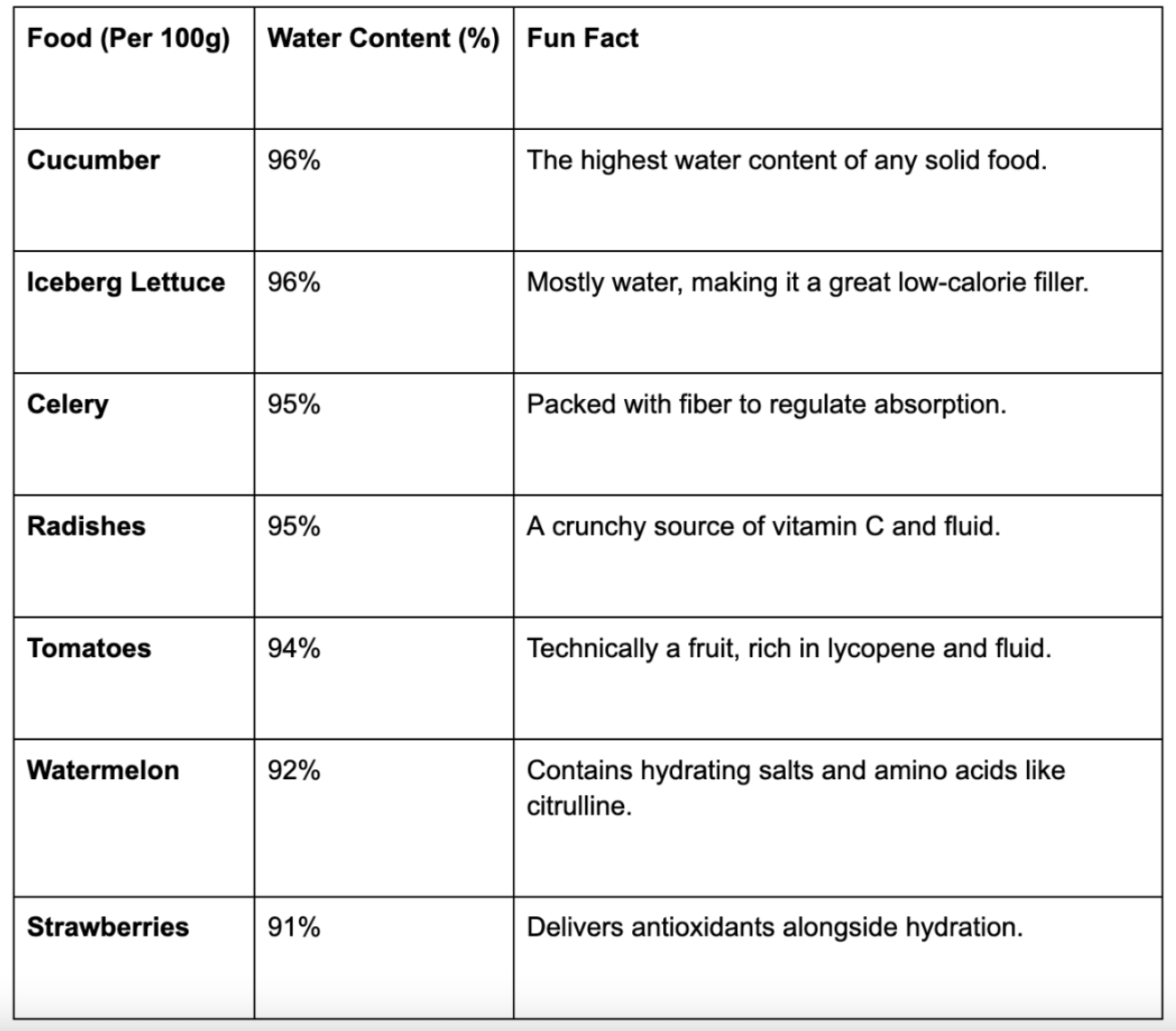
The Takeaway: If you consume just a few cups of these items throughout the day, you've already ingested the equivalent of several glasses of water, along with the necessary cofactors (minerals and fiber) to help your body use it properly.
This Is How I Drink Water
When I do drink water, I add Ultimate Minerals because our food is lacking in minerals, not vitamins.
February is when we’re offering our biggest Ultimate Minerals savings of the entire year.
Our #1 best-selling, most-reordered product is designed to be added to your drinking water – giving your body plant-derived minerals it can truly use, with no fillers or preservatives and rigorous heavy-metal testing.
Put a dropperful in water, leave the jar in the sun for an hour or more, and you’ve got “structured” water! Far more hydrating, according to water expert Dr. Gerald Pollack.
It’s tasteless, simple, and loved by families who report more energy, better sleep, fewer sick days, and healthier skin, hair, and nails.
Get Your Biggest Savings All Year Here!
The Verdict: Listen to Your Body, Not a Myth
The counter-narrative is clear: The "eight glasses of water" rule is an oversimplification based on a misread nutritional guideline from 1945. It ignores food-based fluid, relies on fear-mongering about urine color, and can even push people toward dangerous over-hydration.
Do you need to drink half a gallon of water every day?
No. For most healthy adults, the key is to drink when you are thirsty and to enjoy a diet rich in whole foods, which inherently contributes high-quality, structured fluid. Your body is not a machine that needs to be refilled on a timer. It’s a self-regulating organism. Trust the signal it’s been perfecting for millennia.
I’m going to send this to my kids, who have those big water jugs that encourage you to drink half a gallon of water a day because they do 75 Hard. You’ve seen people carrying around half-gallon water jugs, demarcated with the daily 64 oz. of water goal.
I love my kids doing 75 Hard. I just don’t think they need that much water.
Want More Insider Truths About What’s Really Worth Your Time (and Money) for Your Health?
I teach regular health coaching classes if you would like to join me for a conversation like this, plus several other topics, once a month.
You’ll also receive access to my video courses with my functional-medicine doctor colleagues – on prevention of EMF, breast cancer options, biological dentistry, and natural hormone treatment.
Join us – three months for the price of two. Use the coupon code COACH for an extra $50 off!
 Robyn Openshaw, MSW, is the bestselling author of The Green Smoothies Diet, 12 Steps to Whole Foods, and 2017’s #1 Amazon Bestseller and USA Today Bestseller, Vibe. Learn more about how to make the journey painless, from the nutrient-scarce Standard American Diet, to a whole-foods diet, in her free video masterclass 12 Steps to Whole Foods.
Disclosure: This post may contain affiliate links that help support the GSG mission without costing you extra. I recommend only companies and products that I use myself.
References for Structured Water (EZ Water)
The concept of the "fourth phase of water" is primarily championed by Dr. Gerald Pollack, a professor of bioengineering at the University of Washington.
1 — The Foundational Text (The Deep Dive)
- Source: Pollack, Gerald H. (Book, 2013).
- Why it's essential: This book introduces the concept of Exclusion Zone (EZ) water (the term for structured water in his lab) forming near hydrophilic (water-attracting) surfaces. It posits that this water is highly ordered, has a negative charge, and acts more like a liquid crystal or gel, which is why it is abundant inside living cells, in a more usable form.
2 — Peer-Reviewed Evidence (The Science Anchor)
- Source: Review Article: Huszár, C. P., Heszler, B., & Pukánszky, B. (2020). Exclusion Zone Phenomena in Water—A Critical Review of Experimental Findings and Theories. PMC - NIH (Published in Colloids and Interfaces).
- Why it's essential: This article confirms that the "Exclusion Zone (EZ)" phenomenon itself has been independently demonstrated by several groups – meaning water does behave differently near hydrophilic surfaces. While it presents alternative explanations to Pollack's structure theory, citing it indicates that the observation that water is excluded from these surfaces is scientifically accepted.
3 — Biological Relevance (The Food Connection)
- Source: Research Gate/Pollack Lab Publications. EZ Water and the Origin of Life (2022) or related papers.
- Why it's essential: Pollack's work explicitly states that almost all water inside a living cell is present as EZ water. Since plants (fruits and vegetables) are made of cells, this provides the powerful scientific rationale for why the water inside a cucumber is different from water in a glass. This directly supports the idea that you're getting water in a "more usable form."
4 — Skepticism and Nuance (The Balanced View)
I don’t want to assume that Gerald Pollack’s work is the end of the road – the fact is, few scientists have followed up and done additional research.
I’ve gone through all the studies on structured water in PubMed, and while there are some impressive ones, nobody’s done the big-bucks large studies. Most of the studies were done on livestock. Let’s consider it to still be the subject of scientific debate.
- Source: University of New South Wales (UNSW) Article: Schmidt, T. (2022). Don't fall for the snake oil claims of 'structured water'. A chemist explains why it's nonsense.
- Why it's essential: This provides the critical counterpoint. Chemists argue that the formula Pollack hypothesizes is chemically unstable and that other phenomena (like surface tension or simple confinement) explain the exclusion zone without needing a "fourth phase."

Posted in: Lifestyle, Preventive Care, Whole Food