

The Blue Light Blocker Buzz: Do Those Special Glasses Really Work?
Let’s talk about blue-light blockers! You’ve been told blue light glasses protect your eyes. But what if that’s not actually true?
My research here surprised no one more than it surprised me.
I’ve 100% bought into the blue-blocking narrative for many years.
To watch or listen to this blog post instead, click here.
Here's what you'll read about in this article:
- What is blue light? And is it harmful?
- What real science says about blue light glasses
- Rating blue light glasses
- Should you get the blue light coating on prescription glasses?
- How to reduce digital eye strain naturally
- Want to protect your eyes naturally?
You know how you spend a lot of time on your phone, tablet, or computer? Scrolling through TikTok, doing homework, or gaming?
(Especially after doing this research, I think the constant fixed bending of the neck downward may be much worse than the effect on the eyes, personally. And the data on this will be coming out in future years, I’m sure. You see the cashew-shaped kids everywhere, right?
Well, you've probably seen ads for special glasses that claim to block "blue light" and save your eyes. They say this blue light is super bad for you, causing headaches, making your eyes tired, and messing up your sleep.
And these glasses, often with a slight yellow or orange tint, cost a good chunk of money.
But, is this whole "blue light" thing a real danger, or is it just clever marketing trying to get you to buy something you don't really need? If there are benefits, what are they?
Today, we're going to act like detectives and look at what real science, not just ads, has to say about those blue light blocking glasses.
Part 1: What Is Blue Light (And Is It Harmful?)
First, let's talk about blue light.
Think about all the different colors in a rainbow. Each color is a type of light with different energy. Blue light has a lot of energy and short waves. The ads make this sound super scary, like blue light is zapping your eyes.
But here's a secret that the companies selling these glasses don't want you to know:
A minute in the sun gives off WAY more blue light than your phone or computer ever could.
If blue light itself were super dangerous, everyone would be walking around blind just from being outside on a sunny day. And our ancestors, who spent all their time outdoors, would have gone blind ages ago. So, blue light isn't a new monster created by screens.
So, if blue light isn't the problem, why do our eyes feel so tired and achey after looking at screens all day?
It's called Digital Eye Strain. When you stare at a screen, you forget to blink.
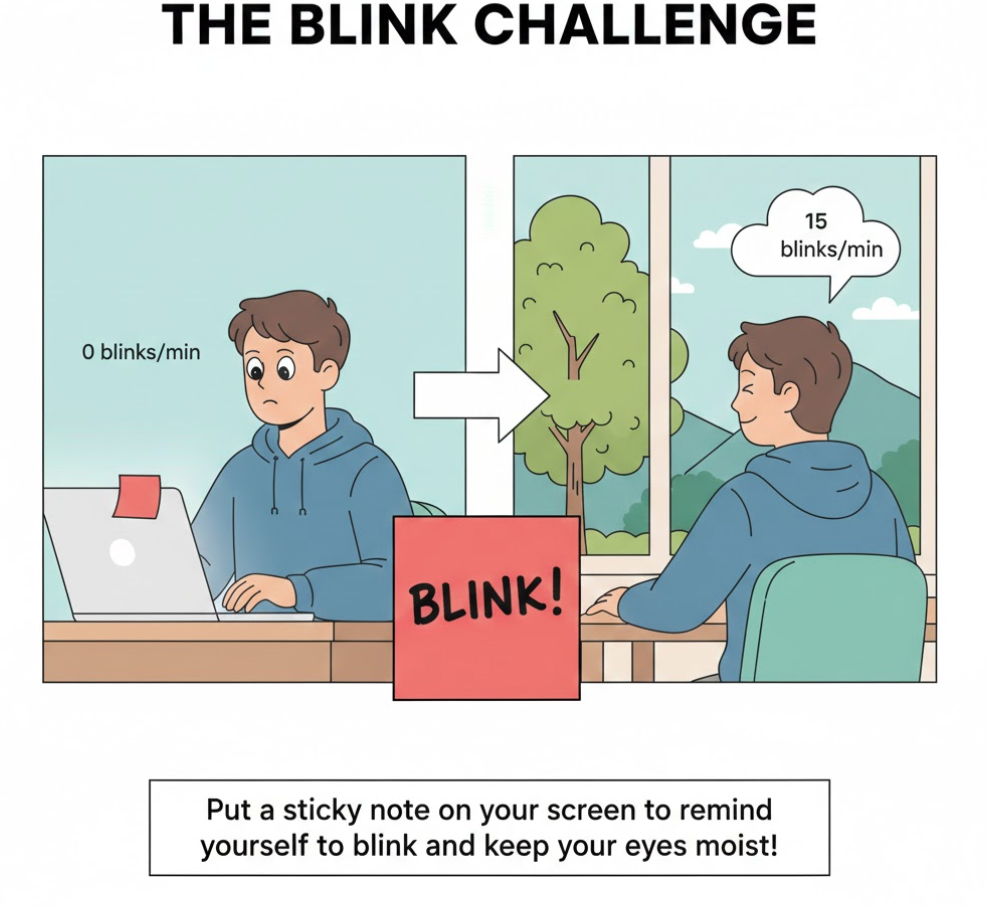
Normally, you blink about 15 times every minute to keep your eyes moist. But when you're super focused on a screen, you might only blink 5 or 7 times a minute.
Your eyes get dry, and the muscles inside your eyes get tired from focusing on the same spot for a long, long time. It's like holding your arm out straight for hours – it would get tired, right? Your eyes do, too!
I have tips for decreasing eye strain below. I have experienced it, too. I have been writing and working online full-time for 18 years now.
Part 2: What Real Science Says About Blue Light Glasses

The truth? Meta-studies couldn't find any good proof that blue-light-blocking glasses actually help with tired eyes or sleep problems.
Let's put on our science hats and look at what actual eye doctors and researchers have found.
We're talking about studies published in places like PubMed, where you and I may doubt a study, due to industries that fund research, but it’s also where a lot of legitimate medical research lives.
I rely on Cochrane.
The Big Research Review (Cochrane Review, 2023)
Imagine a team of super-smart scientists who gather ALL the studies on a topic and look at them together. That's what the Cochrane Database of Systematic Reviews did for blue-light-blocking lenses. They reviewed 17 studies from 6 countries.
I like Cochrane meta-studies because they tend to be unbiased by industries. Guess what they found?
They couldn't find any good proof that blue-light-blocking glasses actually help with tired eyes or sleep problems. They worked just as well as plain, clear glasses. (Spoiler: meaning they didn't really work any better than nothing at all).
With one exception: there was a minor improvement in melatonin production for those who wear very dark-tinted glasses for 2 hours before bed. It may somewhat help with sleep.
Related: 7 Things You Need to Know About Sleep — Including, Do You Really Need 8 Hours?
What Eye Doctors Say About Blue Light Glasses
The American Academy of Ophthalmology (AAO) is like the head office for eye doctors in America. They've said directly:
"The American Academy of Ophthalmology does not recommend blue light-blocking glasses because there is no evidence that blue light from digital devices is harmful to the eye."
Pretty clear, right? The people who know the most about eyes aren't recommending them.
The "Mind Trick" Study
Some studies have even shown something called the "placebo effect." That's when you think something is helping you, so you feel better, even if the thing isn't actually doing anything. In one study, some people got blue-light glasses, and some got regular clear glasses.
Both groups said their eyes felt a little better. Why? Because putting on special glasses made them think about their eyes more, so they might have taken more breaks or blinked more without even realizing it. The glasses themselves weren't doing the magic!
The truth is that I’ve been wearing blue-light glasses all day at work (and if I watch TV or engage with a screen at night) – for 5+ years, and for the first few years, I felt my eyes were less tired at the end of each day. Placebo effect? I don’t know. The science suggests that.
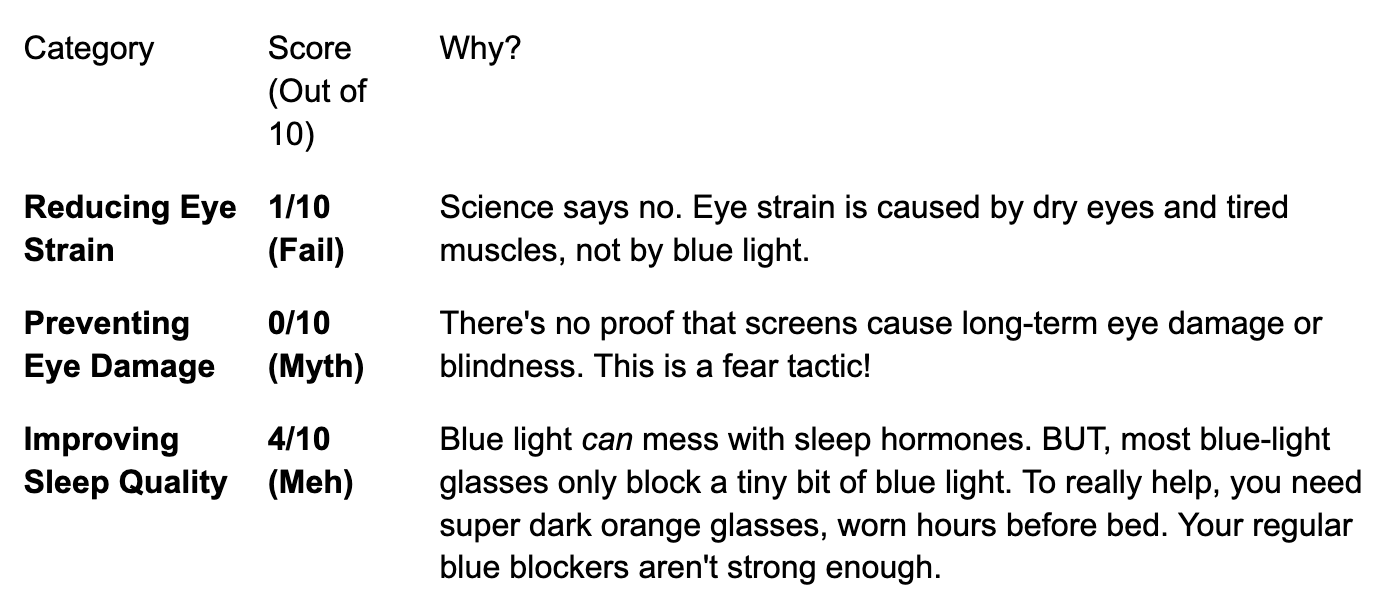
Part 3: Rating Blue Light Glasses (Our "No-Hype" Scorecard)
Based on all this science, here's our honest scorecard for blue light glasses:
Part 4: "I Need Prescription Glasses – Should I Get the Blue Light Coating?"
This is where things get tricky at the eye doctor's office. You pick out cool new frames, and then they ask, "Do you want to add the blue light protection for an extra $50?" It sounds like a good deal to "protect" your eyes, right?
Here's how to be smart about it:
- It's Expensive for What It Is: That blue light coating probably costs the company just a few cents to put on your lenses, but they charge you a lot more.
- You Might Already Have It: Many newer, thinner prescription lenses (called "high-index" lenses) actually have some built-in blue light filtering without any extra coating. You could be paying for something you already have!
- If You REALLY Want It: Instead of a coating (which can sometimes scratch or peel), you can ask for "blue-light filtering monomer." This means the blue-light blocker is mixed right into the plastic of the lens, so it's part of the glass itself and can't wear off.
My advice?
Save your money. Take that $50 and spend it on healthy foods like spinach, kale, and collard greens.
These foods are packed with things called lutein and zeaxanthin, which are like natural sunglasses for your eyes and actually help keep them healthy from the inside out. Your eyes will thank you more for a healthy green smoothie than for a tiny yellow tint!
Part 5: How to Reduce Digital Eye Strain Naturally (That Actually Works)
Since those special glasses aren't the answer, what can you do to feel better after a long day of screen time?
Here are some simple, free tricks that actually work:
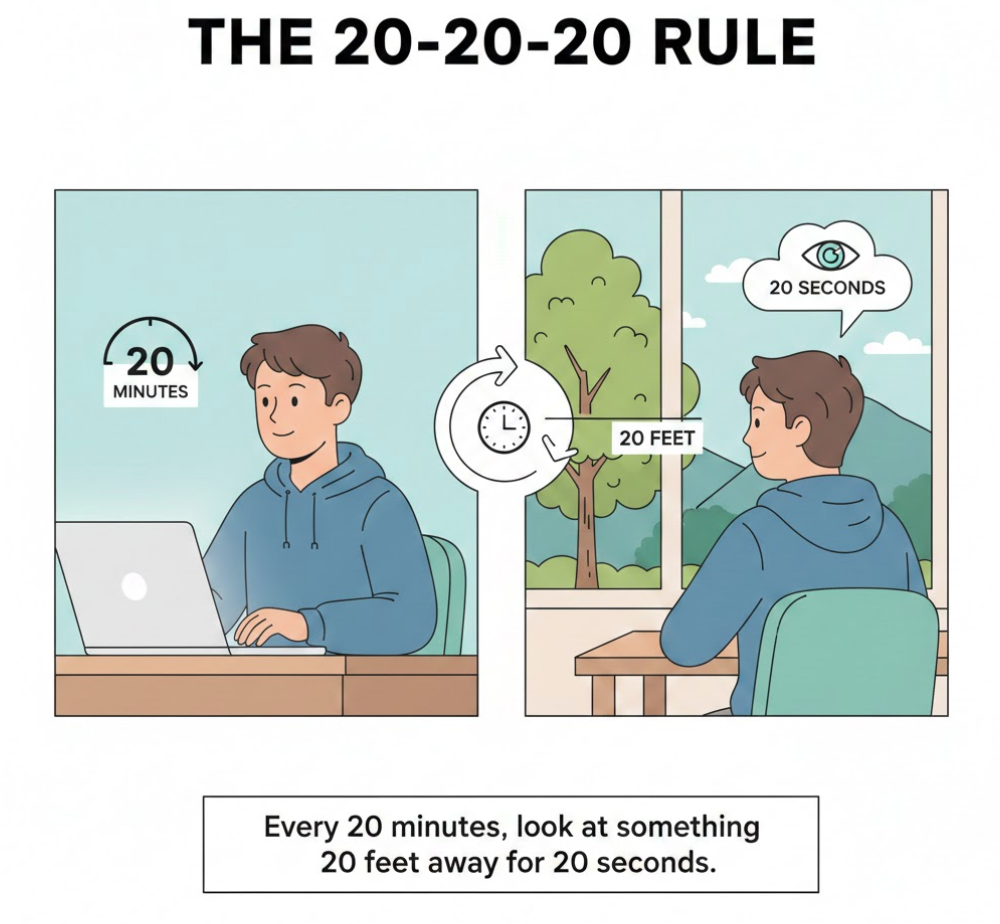
- The 20-20-20 Rule: Every 20 minutes, look away from your screen at something about 20 feet away for at least 20 seconds. This gives your eye muscles a little break and helps them relax.
- Palming: Close your eyes a couple of times a day and lightly press your palms against them. This is part of the “Bates Method” from 100 years ago, and some studies refute that his methods work, but they are very common sense, and even now, there are Bates Method practitioners who claim, at least, that they’ve helped restore people’s vision and decrease eye strain.
- Swing your eyes around the room or environment. Don’t fixate for more than a few minutes at a time. This is another “Bates Method” aspect, which some studies say changes nothing, but I think it’s very common sense. Good for your neck, too.
- I can’t prove that my breakfast of Hot Pink Breakfast Smoothie for 30 years is why I have no prescription lenses, as I’m turning 59, but that’s my guess. So many carotenoid antioxidants are known to improve vision. (And not from a synthetic pill.) Here’s my most famous recipe!
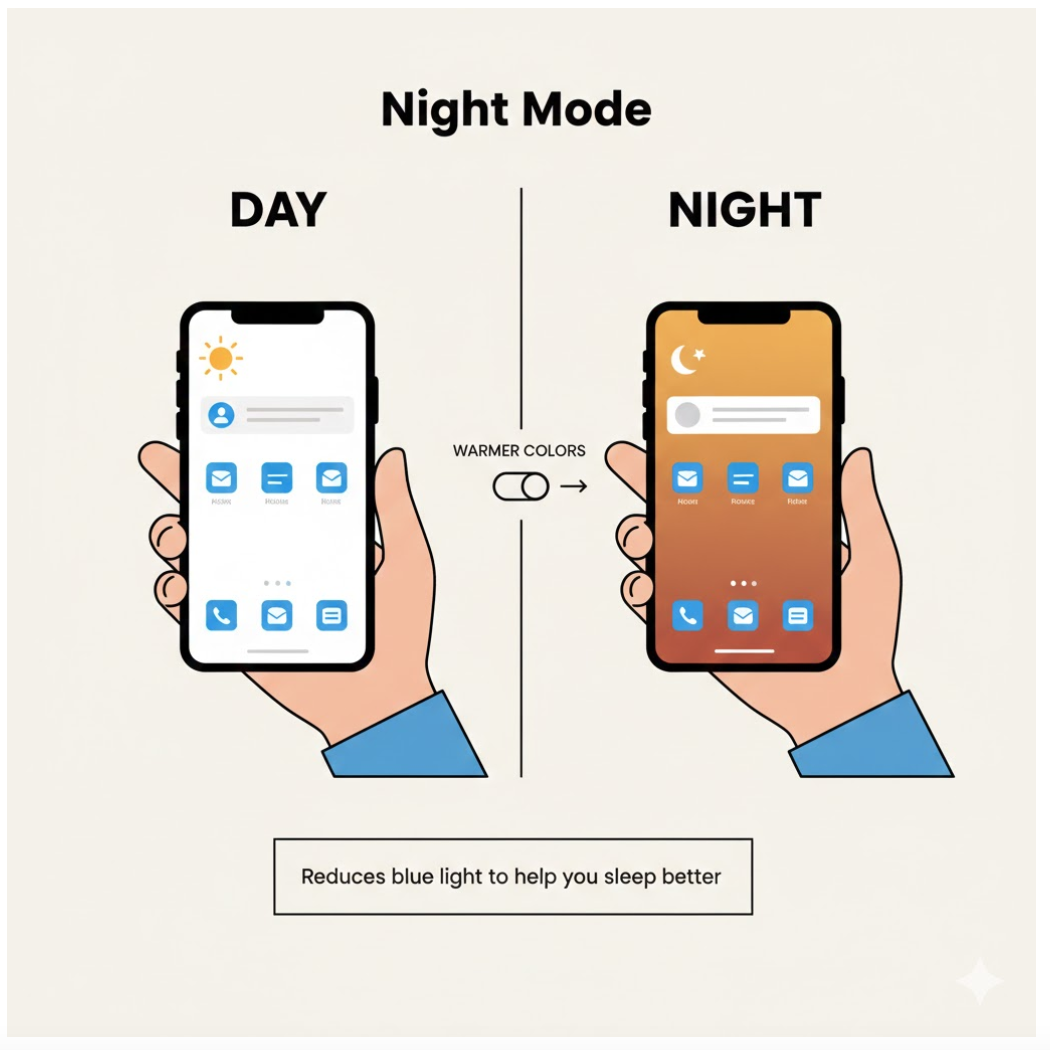
- Use "Night Shift" or "Night Mode": Your phone and computer probably have a setting that makes the screen look warmer and more orange, especially at night. It's called "Night Shift" on iPhones and "Night Light" or similar on other devices. This setting does the same thing as strong blue-light-blocking glasses, but it's built in and free! Turn it on a few hours before bed to help your body get ready for sleep.
- The Blink Challenge: Seriously, try it! Put a sticky note on your computer screen that says "BLINK!" It might sound silly, but reminding yourself to blink more often is a super simple way to keep your eyes from drying out and feeling sore.
Want to protect your eyes naturally?
Start with nutrition. Join my FREE Spring 9-Day Green Smoothie Challenge and give your eyes the nutrients screens can’t.
Read Next: Holistic Ways to Protect Your Eyes: Easy Daily Habits for Lifelong Vision
 Robyn Openshaw, MSW, is the bestselling author of The Green Smoothies Diet, 12 Steps to Whole Foods, and 2017’s #1 Amazon Bestseller and USA Today Bestseller, Vibe. Learn more about how to make the journey painless, from the nutrient-scarce Standard American Diet, to a whole-foods diet, in her free video masterclass 12 Steps to Whole Foods.
Disclosure: This post may contain affiliate links that help support the GSG mission without costing you extra. I recommend only companies and products that I use myself.
Frequently Asked Questions About Blue Light Glasses
Do blue light glasses actually work?
Most high-quality research shows that blue light glasses do not significantly reduce eye strain or prevent eye damage.
While they may feel helpful to some people, this is often due to behavioral changes (like taking more breaks), not the glasses themselves.
Do blue light glasses help with eye strain?
No, digital eye strain is not caused by blue light.
It’s mainly caused by:
- Reduced blinking
- Dry eyes
- Focusing on a screen for long periods
Simple habits like blinking more and taking breaks are far more effective.
Can blue light from screens damage your eyes?
According to organizations like the American Academy of Ophthalmology, there is no evidence that blue light from screens causes permanent eye damage.
In fact, natural sunlight exposes you to much higher levels of blue light than any device.
Do blue light glasses help you sleep better?
Maybe, but only slightly.
Very dark, orange-tinted lenses worn for 1–2 hours before bed may help support melatonin production. However, most standard blue light glasses are too weak to make a meaningful difference.
Are blue light glasses worth buying?
For most people, no.
They are often expensive and don’t address the real cause of discomfort. You’ll get better results from free habits like:
- Using “Night Mode” on devices
- Following the 20-20-20 rule
- Blinking more
What actually helps reduce digital eye strain?
The most effective (and free) strategies include:
- 20-20-20 rule: Every 20 minutes, look 20 feet away for 20 seconds
- Blinking more often to prevent dry eyes
- Adjusting screen brightness and distance
- Taking regular breaks
Is blue light bad for your health overall?
Blue light itself isn’t “bad” – it’s a natural part of sunlight and plays an important role in regulating your circadian rhythm.
The real issue is too much screen exposure at night, which can disrupt sleep patterns – not damage your eyes.
Should I add blue light coating to prescription glasses?
In most cases, it’s not worth the extra cost.
Many modern lenses already include some filtering, and the added coating doesn’t meaningfully improve eye comfort or protection.
What’s the best natural way to support eye health?
Nutrition plays a powerful role. Foods rich in antioxidants like lutein and zeaxanthin (found in leafy greens) help protect your eyes from within – far more effectively than external coatings or lenses.
Posted in: Health Concerns, Holistic Care, Preventive Care, Whole Food









I learned a few years ago that Costco automatically included “blue-light-blocking” to their Rx glasses. I had no idea until I picked them up and they told me. I thought, “maybe that’s a good thing”, so I left. THEN, I started to research and found that we NEED the full spectrum light all day, so now I’m wearing glasses that block out some, or all, of the blue light EVERY SINGLE day? I probably should have returned them, but I didn’t. I ended up getting another pair the following year (from another another retailer) and specifically asked to NOT have that included. From that point on I switched back and forth from my regular glasses during the day to my BLB glasses at night – and used them until after the sun came up in the morning. After reading your article, I just learned that I can probably end this ritual. LOL!
The marketing and influencer world is alive and well and thriving on the strong belief that their customers will fall for all their “health” hype. I don’t know about you, Robyn, but (at 73 years old) I’m pretty over all of it. ;-(
Thanks for all the deep-dive research you do!
I bought blue-blocking glasses from a very reputable and popular EMF blocking company for around $30, but had to return them because I could not see clearly out of them – everything was slightly blurred which probably causes other problems.
Thank you for this article. I was trying to decide whether or not to spend more money on blue light readers. Your article is filled with useful information and it is very helpful.