What Are Multivitamins Really Made Of? The Truth Behind Those ‘Healthy’ Pills

What Are Multivitamins Really Made Of? The Truth Might Shock You
We’ve been told our multivitamin is a safety net – a little daily insurance policy for nutrition.
We picture bright fruits and vegetables concentrated into a capsule: nature’s goodness, minus the chopping.
But when you really ask what multivitamins are made of, the truth is far from anything you’d find in a garden.
What if that pill you swallow each morning is closer to something from a chemical lab than a garden?
Instead of oranges, spinach, or carrots, most multivitamins are created using coal tar, petroleum solvents, ammonia, acetone, GMO-corn byproducts, and leftover minerals from industrial waste streams. These synthetic isolates are then bleached, pressed, polished, and sold as “health.”
It’s efficient. It’s profitable. And it’s absolutely nothing like food.
How the Supplement Industry Became Industrialized
The irony is painful: the very same companies that make chemotherapy drugs and fertilizers also make your “vitamins.”
The base materials often come from waste streams – whatever’s cheap, abundant, and won’t kill you quickly.
The lumber industry’s sawdust becomes cellulose (a “filler”).
Ore mining leftovers become “minerals.”
Petrochemical solvents extract “nutrients.”
Then everything’s bleached, blended, and pressed into the snow-white pills we think are “pure.”
It’s efficient. It’s profitable. And it’s perfectly legal.
The Shocking Ingredients Behind Most Multivitamins
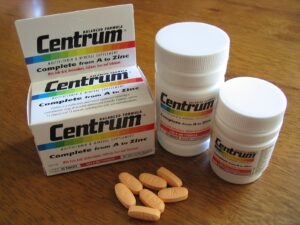
The very same companies that make chemotherapy drugs and fertilizers also make your “vitamins.”
Let’s look at what’s really behind those scientific-sounding names:
- Vitamin D (cholecalciferol): Derived from the grease in sheep’s wool or lab-grown algae, processed through five chemical steps.
- Vitamin C (ascorbic acid): Usually a GMO-corn byproduct processed with acetone or isopropyl alcohol.
- Vitamin A: Created from acetone and processed palm oil – not from carrots.
- Vitamin B1, B2, B3: Made from coal tar, ammonia, and formaldehyde.
- Vitamin B12 (cyanocobalamin): A synthetic compound combining cobalt (a heavy metal) and cyanide.
- Folic acid (B9): A petroleum-based, toxic imitation of the natural folate found in leafy greens.
Would you feed your child anything described that way if it didn’t come in a shiny bottle labeled “vitamin”?
Are Synthetic Vitamins Made From Real Food? (Spoiler: No)
Do the math on your vitamin C supplement.
A bottle of “1,000 mg” tablets costs maybe $50 for 250 servings – 20 cents a pill.
If that were really the concentrated nutrition of ten oranges, you’d be getting $10 worth of fruit for 20 cents.
And yet the pill is bright white.
When was the last time you saw a white orange?
The truth: if vitamin C pills were actually made from food, they’d be orange. And they’d cost as much as food does.
Make sure to read my book Take Daily: How Supplements Hijack Our Health.
I spent hours educating my co-author, Mike, who has never taken supplements–and then he went off to research, and was mind blown.
Why the “Science” Sounds So Convincing
We’ve been trained to equate science-y names with credibility. Pyridoxine sounds smarter than banana.
We read “cholecalciferol” and assume, “That must be the real vitamin D.”
It’s not.
It’s an industrial replica that mimics one molecule of a vitamin found in nature — but none of the cofactors, enzymes, or living synergy that make food-based nutrients work in your body.
The supplement industry knows this. You can learn it yourself: go ask ChatGPT or another AI program what all the parts of vitamin C are. (To the extent “science” even understands it.)
But why tell you, when the illusion sells so well?
Ask AI how they get away with it. It’ll tell you, in so many words, well, because they’ve been doing it for so long, and no one’s stopped them.
My Wake-Up Call: When Synthetic Solvents Showed Up in My Blood
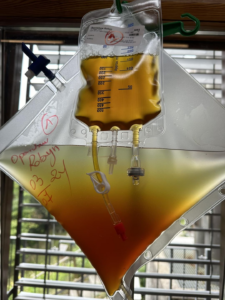
These petrochemical solvents (the smaller bag) came out of my body in a blood-filtering process in Switzerland.
After two decades of eating clean, detoxing twice a year, and taking more supplements than most people take in a lifetime, I finally put my faith to the test.
During a detox retreat at the Swiss Mountain Clinic in 2024, I underwent INUSpheresis, a medical filtration that removes metals and chemicals from the blood.
The result: nearly a quart of shimmering waste – full of solvents and residues – filtered out of my bloodstream.
I was stunned. I eat a 95% organic diet. I don’t take pharmaceuticals. So where did all that come from?
The answer, in hindsight, was obvious: decades of “health supplements.”
Solvents are involved in virtually all of them. Most solvents are petrochemical.
What Science Says: Multivitamins Don’t Work
Multiple large-scale studies show that multivitamins don’t prevent disease, extend life, or improve health.
A 2013 Annals of Internal Medicine editorial titled “Enough Is Enough: Stop Wasting Money on Vitamin and Mineral Supplements” analyzed data from hundreds of thousands of people.1
Its conclusion:
“Multivitamins do not reduce the risk for heart disease, cancer, cognitive decline, or early death.”
In fact, daily supplement users had a 4% higher mortality risk than non-users.
Yes, higher.
Sometimes the data is much, much worse than that, including being linked to a higher risk of cancer and all-cause mortality.
Don’t miss the chapter on “vitamin A” and “beta-carotene” in Take Daily.
But Aren’t Trace Toxins Safe?
Supplement manufacturers like to say that “trace amounts” of heavy metals or solvents are harmless.
But whose idea of “acceptable” are we trusting?
The FDA’s own “acceptable limits” for contaminants are based on incomplete data — and the FDA doesn’t test supplements before they’re sold.
Meanwhile, thousands of small “brands” simply white-label the same formulations from the same chemical factories, changing only the label design and influencer endorsement.
Why Whole-Food Nutrients Beat Synthetic Isolates

Oranges, carrots, or beets knows how to nourish you in ways no capsule can mimic!
Your body doesn’t crave “isolates.” It craves synergy.
It doesn’t recognize cyanocobalamin (falsely called “Vitamin B12). It recognizes food.
It doesn’t need 1,000 milligrams of anything. It needs balance.
Whole foods already contain vitamins in perfect proportions, wrapped in fiber, enzymes, and color.
That orange, carrot, or beet knows how to nourish you in ways no capsule can mimic.
Your Wake-Up Challenge
Tonight, go to your cabinet.
Pick one supplement. Type one ingredient into a search engine with the words:
“Chemical processes used to manufacture [ingredient name].”
Read what you find.
Then ask yourself: would you eat that if it hadn’t been sold to you by someone you believe knows more than you do, about your health? With a healthy-looking label?
The Takeaway: Time to Trade the Capsule for a Carrot
The multivitamin myth is one of the most expensive illusions in modern health.
The same companies that sold us “safe and effective” drugs are now selling us “natural and essential” vitamins – using the same factories, solvents, and marketing playbooks.
It’s time to trade the capsule for a carrot. The bottle for a blender. And the fairy tale for the truth.
Ready to Go Deeper?
This post is adapted from Chapter Two of Take Daily: How Supplements Hijack Your Health by Robyn Openshaw and Mike Fairclough – the investigative book Big Pharma doesn’t want you to read.
A book that might just save you thousands of dollars a year. And save you a lot of strain on your kidneys and liver.
Uncover what’s really hiding in your vitamins!

FAQs About What Multivitamins Are Really Made Of
What are multivitamins really made of?
Most multivitamins are made from synthetic chemicals – including coal tar derivatives, petroleum solvents, GMO-corn byproducts, ammonia, and industrial mineral waste. They are not made from food.
Are synthetic vitamins bad for you?
Studies show synthetic vitamins offer little to no health benefit and may increase certain health risks, including cancer and all-cause mortality, especially when taken daily in high doses.
What is the difference between whole-food vitamins and synthetic vitamins?
Whole-food vitamins come from real foods and contain enzymes, phytonutrients, and cofactors the body recognizes. Synthetic vitamins are lab-made isolates that lack synergy and often contain chemical residues.
Do multivitamins actually work?
Large-scale research – including a 2013 Annals of Internal Medicine review – shows multivitamins do not reduce the risk of disease or improve overall health.
How can I tell if a vitamin is synthetic?
If the ingredient list includes chemical names like “ascorbic acid,” “cyanocobalamin,” “dl-alpha-tocopherol,” or “folic acid,” it’s synthetic. Real food doesn’t look like that.
Read Next: The Secret Marriage of Big Pharma and Big Supplement
 Robyn Openshaw, MSW, is the bestselling author of The Green Smoothies Diet, 12 Steps to Whole Foods, and 2017’s #1 Amazon Bestseller and USA Today Bestseller, Vibe. Learn more about how to make the journey painless, from the nutrient-scarce Standard American Diet, to a whole-foods diet, in her free video masterclass 12 Steps to Whole Foods.
Disclosure: This post may contain affiliate links that help support the GSG mission without costing you extra. I recommend only companies and products that I use myself.
References
- Guallar, E., Stranges, S., Mulrow, C., Appel, L. J., & Miller, E. R., 3rd (2013). Enough is enough: Stop wasting money on vitamin and mineral supplements. Annals of Internal Medicine. https://doi.org/10.7326/0003-4819-159-12-201312170-00011
Image Notes
- Centrum image used under the Creative Commons Attribution-Share Alike 2.0 Generic license via Flickr user Smoth 007
Posted in: Health Concerns, Natural Products, Natural Remedies, Preventive Care, Supplements