

What About Oxalates in Spinach?
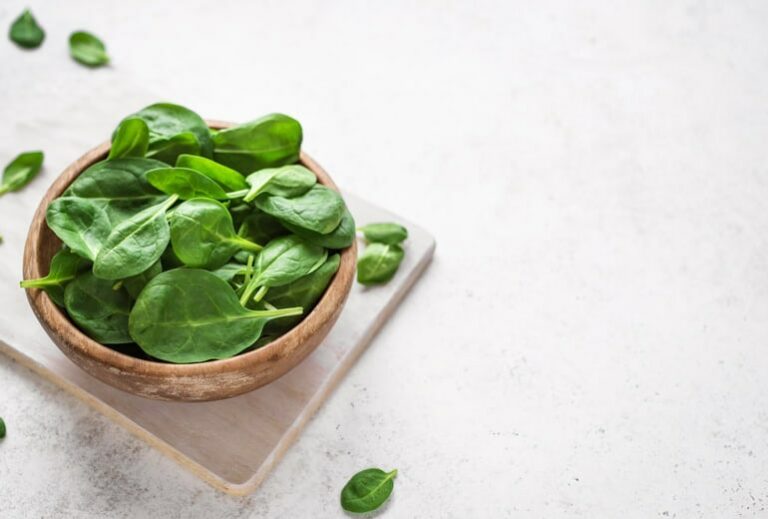
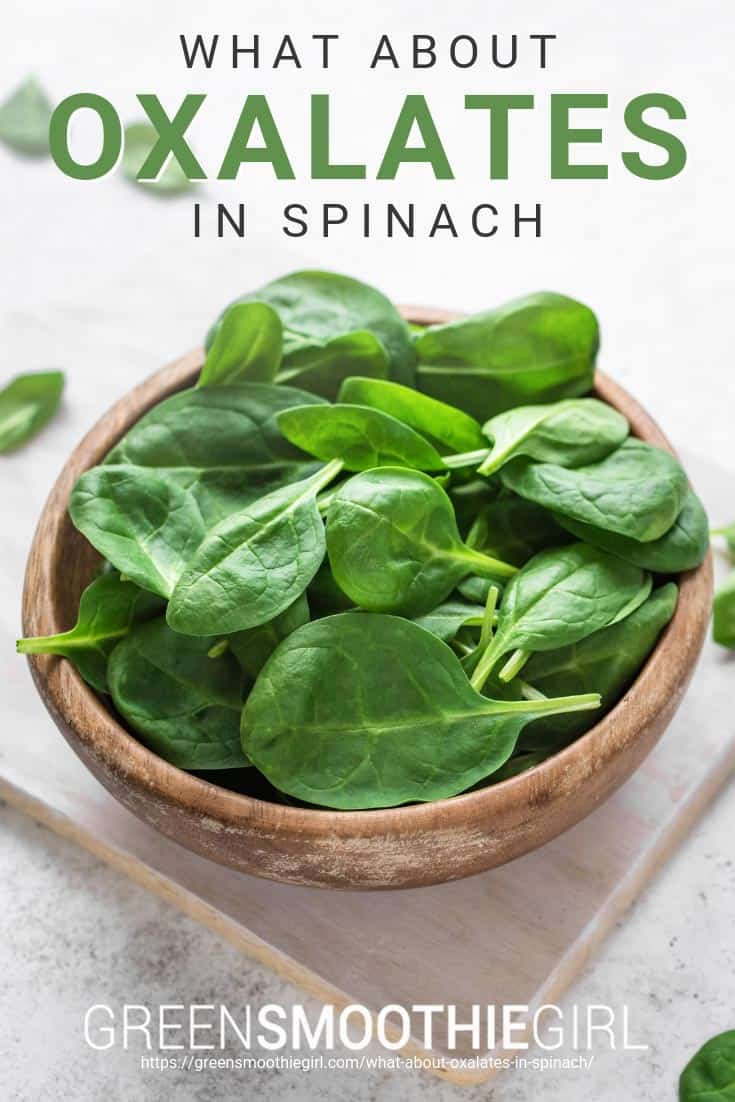
Dear GreenSmoothieGirl, some people think you should lightly cook your spinach and other greens before eating them. Is it safe to eat them raw? What about spinach oxalate?
In this article:
- It’s Safe to Eat Raw Oxalate Foods
- The Truth About Dietary Oxalates
- Who Should Stick to Low Oxalate Diet Recipes?
Why You Need Oxalate Foods
It’s Safe to Eat Raw Oxalate Foods
Answer:This is an excerpt from Ch. 1 of my book,12 Steps to Whole Foods.
It is both safe and good to eat spinach raw, which I have done every day for 15 years.
Cooking, by any method, kills 100% of the greens' enzymes – which are critical nutrients that support digestion and overall health.
Misconceptions About Spinach Oxalates
A popular theory among those interested in nutrition is that greens (especially spinach) are high in oxalates and should be avoided because oxalates cause kidney stones or gallbladder problems and may interfere with absorption of calcium in the body. Another popular opinion is that cooking spinach renders the oxalates harmless.
The Truth About Dietary Oxalates
Peer-reviewed research shows that the effect of oxalates on calcium absorption is small and does not outweigh spinach’s calcium contribution.
Only a few rare conditions — absorptive hypercalciuria type II, enteric hyperoxaluria, and primary hyperoxaluria — require oxalate restriction. These are not the more common kidney stones that many worry about.
Some foods once thought to increase stone formation, like black tea, may actually have protective effects.
Cooking spinach lowers oxalate content minimally (about 10%), and raw greens retain the majority of their nutritional benefits.
Oxalates in spinach don't change significantly when the leaves are cooked.
You Can’t Significantly Lower the Oxalate Content of Foods
Cooking has a small impact (about 10%) on the oxalate content of foods, with no statistically significant lowering of oxalates following blanching or boiling of greens.
It appears that the nutritional advantages of eating raw greens continue to far outweigh any benefit of cooking them.
Should We Be Terrified of Oxalates?
I don’t disagree that a small subset of people may have difficulty metabolizing greens, especially if their gut health is compromised. But greens offer unique nutrients that are critical for virtually everyone. Eliminating them — or cooking them to the point of destroying their enzymes — because a few people might react poorly is a logical fallacy.
Kidney stones and other oxalate-related issues usually result from long-term patterns such as high intake of soda, salty foods, animal proteins, and low water consumption — not from the occasional smoothie or salad.
Greens may even help prevent kidney stones, along with many other chronic modern health risks. Read Victoria’s report here.
Also, consider supplements:
Overdoing minerals from chalky tablets and powders may contribute more to oxalate concerns than naturally occurring oxalates in food. The real issue is often supplement overuse rather than leafy greens themselves.
Who Should Stick to Low Oxalate Diet Recipes?
Two other compounds—purines and goitrogens — are found in some greens (spinach, broccoli, cauliflower). Excessive intake may be problematic for people with gout, kidney stones, or low thyroid hormone production.
Lightly steaming these foods may help. For most people, a few servings per week are safe and beneficial.
Why You Need Oxalate Foods
Oxalates are only one part of the story. Greens are nutrient-dense, enzyme-rich, and protective against many modern health conditions. For almost everyone, the benefits of consuming raw or lightly cooked greens far outweigh the risks.
What do you think of the oxalate in spinach? Do you have more questions about what are oxalates? Share your thoughts with us in the comments section below!
Read Next: Is Raw Spinach Bad for Me?
 Robyn Openshaw, MSW, is the bestselling author of The Green Smoothies Diet, 12 Steps to Whole Foods, and 2017’s #1 Amazon Bestseller and USA Today Bestseller, Vibe. Learn more about how to make the journey painless, from the nutrient-scarce Standard American Diet, to a whole-foods diet, in her free video masterclass 12 Steps to Whole Foods.
Disclosure: This post may contain affiliate links that help support the GSG mission without costing you extra. I recommend only companies and products that I use myself.
Posted in: 12 Steps To Whole Food, Whole Food











I was always taught that you could only eat spinach (and lettuce) once a week because of nitrates.
Now I eat a lot more spinach and lettuce than once a week, but it’s always in the back of my mind: am I getting to much nitrates?
What do you think about this?
Nitrates from whole plants are GREAT. Brain loves nitrous oxide and off product of consuming whole plant based nitrates. Nitrates from cured meats are CANCEROUS.
Many have the same confusion regarding fructose, which is a addictive poison when it is refined from sugar, but fructose is ok when consumed as part of the whole fruit— it’s the fiber that makes it ok to eat.
I would have about 2 cups of spinach in my smoothie every day or every other day. About 3 years ago, I suffered from a kidney stone. I joined the kidney stone prevention group on Facebook followingbthe Harvard list of low oxalate foods. I quit eating spinach since it had so many oxalates. I haven’t had a kidney stone since.
Hi Robyn, very interestd in the comment on low thyroid function and spinach. I have low thyroid (hypothyroid) I have been eating spinach every day, in smoothies and salads and thrown into soups. Should I limit my spinach consumption?
The one thing that I thought about when I read the question was the spinach outbreak 2 years ago. Our family was affected so I thought I’d ad a little bit in case anyone who read was concerned on that front.
If you are worried about food poisoning such as e. coli etc. The truth is that you should wash your spinach but cooking will not help much because you cannot get the spinach to a high enough temp. to kill the e. coli bacteria and have it still be edible. So the short answer is, wash it and hope for the best because unless you like cooked spinach better there’s no reason to do so.
I have an unscientific question regarding spinach.
A long time ago, my grandfather was a farmer in Missouri. He hated spinach and always said that he wouldn’t eat anything the hogs wouldn’t eat. He proved it by giving them left over spinach (assumed it was cooked) and the hogs would not eat it.
A couple of years ago, we planted a garden where we lived in Colorado. We planted lettuce, radishes , spinach etc. We fought the animals, the deer, the rabbits etc but we lost, except on the spinach, they just didn’t eat it???? We really enjoyed it!!
Why do animals not eat spinach? Anyone know?
Anne, the only nitrates you should worry about are the chemical versions in processed meats. Tiffany, I agree. Jeane, interesting–I had no idea!
Wendy, I have low thyroid function, too, and eat spinach virtually every day–some days LOTS. I can’t advise re: medical issues for any specific situation (don’t know your T-3 and T-2 readings, etc. and am not a doctor), but I just hoped with that passage from the book that people don’t worry about eating natural foods, just because one or two people made a big deal about this oxalate issue. I wanted to put it all in perspective. Fact is, so many other things in greens are nourishing for the thyroid; intuitively, it makes no sense to break down all its parts and say to avoid it as a food because of one tiny part. (The alternatives we might eat if we bump out lots of greens are thyroid suppressing in their own right. Soy isolates? Meat? Sugar?)
I have hyperthyroid and take 3 PTU pills each day to control it. Otherwise I am impossible to be with – too much energy, washing kitchen floor at 3 a.m., talking non stop, flitting from one thing to the other. However, thank goodness, it is all controlled through the PTU medication. I also eat tons of raw green stuff every day, either in green smoothies or salads and feel totally wonderful. Next week am having my annual checkup.
Thanks for the above info, Robyn.
What about the effects of spinach and other greens on the viscosity of blood? My mother takes coumadin to thin her blood and has to limit her amounts of greens. This is hard on her because she has always been a health nut. She had an arterial blood clot a couple of years ago and was put on meds to thin her blood so she doesn’t have another clot. Now she has to be careful NOT to eat to many salads. Last year I had had a venous blood clot and am not sure if the huge amounts of green make my blood thicker. I DO know that my cholesterol went from 212 to 167 in the last 3 mos and that I have lost 35 lbs. So I certainly dont want to change what is seeming to work.
I do have a question about my fingernails. They have longitudinal lines down them. I know that it means I am deficient in somthing but I am not sure what. Any ideas?
Anyone taking drugs should follow the warnings of the doctors/pharmacist/drug warning sheet. Coumadin is scary. It’s always frustrating for me to hear that the medical doctors’ protocols not only require all the usual frightening side effects, but also a need to stop or avoid getting good nutrition. That’s rough for your mom.
Although many theorize that various issues relating to mineral deficiencies show up in fingernails, I don’t about the specific long lines complaint. I’m going to be blogging in the near future about getting whole, completely unrefined salts (with 84 trace minerals) in the diet to address mineral deficiencies–which can’t be overstated as a problem in our culture–and at some point I’ll also talk about iodine. You may want to look at both those issues.
Can you give us some sources for your comment “The research is not clear that restricting foods such as spinach helps prevent stones in those who have previously had them. Many researchers believe that dietary restriction cannot reduce risk of stone formation. In fact, some foods that were assumed to increase stone formation because of oxalate content (like black tea) have appeared in more recent research to have a preventative effect.”
All I can find is research telling me to avoid these foods. I am sure you have seen those findings as well. (like https://www.ohf.org/docs/Oxalate2008.pdf)
I want to keep drinking green smoothies and LOVE the hot pink breakfast smoothie but have been feeling more pain in my lower back for the past few months. I want to convince my self to keep going. HELP!
Tiana, read George Mateljan, for one. Oxalates may contribute to stone formation in people who already have some crystallization issues. Overall, it’s a synergistic part of lots of green plants that, with all their other properties, have many preventative effects of course. You would, of course, want to lean on a practitioner for your own very specific health questions.
I know this blog is 10 years old but…Is it bad to eat 250g of frozen spinach each day?
Low oxalate diet is for people with metabolic disorders. They get sandy poop.
Avoid antinutrients in vegetables if you have any problems in gut permeability; which most people do, to varying levels. Vegetables and fiber are not for everyone and what is needed is an assessment of your genetics, epigenetic, and digestive function, before you can safely assume you can eat a huge amount of vegetables. Luckily, most people know what the can and can not eat. However some have very subtle digestive issues that take time and patience to understand. I am not against eating vegetables, but I think that consuming them in large quantities, or eating the recommended servings per day should be taken seriously considering the amount of antinutrients they contain, and the poor digestive function many people have.