

Does “Vitamin C” (Ascorbic Acid) Really Help?
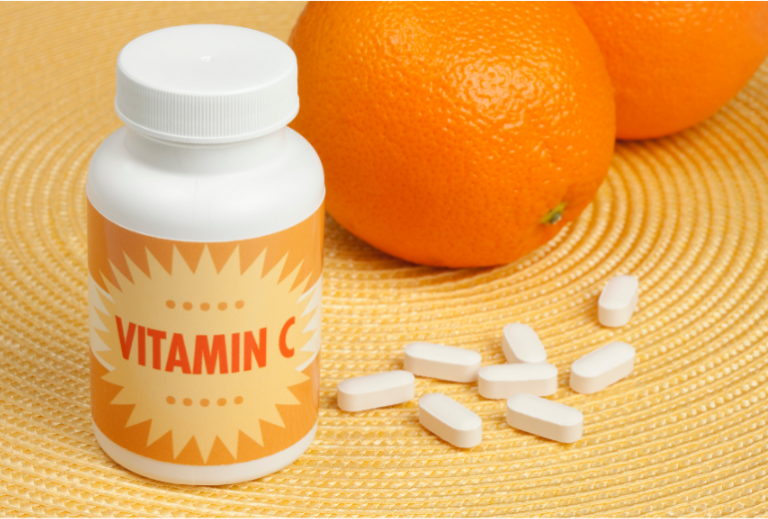
Is that IV bag of Vitamin C actually good for you, and worth the spend? How about the Vitamin C pills you may take?
I spent two hours on the internet trying to figure out what is in the bag of IV ascorbic acid, which you are told is Vitamin C.
I wanted to know how it’s made. How close it really is to the actual vitamin we know to be important for many functions in the human body.
Now you know that foods high in Vitamin C are brightly colored fruits and vegetables. So, why is that IV bag clear in color–like water, and other IV drugs?
Well, whatever you think about whether IV vitamin C works, the fact is, this product has been made in China from synthetic ingredients since the 1960’s.
The ingredients include not just a cheap, synthetic version of ascorbic acid derived from the dextrose of genetically modified corn—but it also uses heat, and solvents like acetone, which is nail polish remover.
In fact, there are five chemical processes the product goes through, before it ends up in that IV bag.
I take just one Vitamin C supplement because it’s not ascorbic acid; I don’t take it every day because I already eat a whole-foods diet high in Vitamin C.
But because there’s some evidence that taking large doses of Vitamin C is useful when you have symptoms of illness, the only C I take is by a brand called Pure Radiance.
The ingredients are camu camu, amla berries, cranberries and blueberries, rose hips, and other whole superfoods, mostly berries–where I’m not getting a synthetic product.
Since that synthetic ascorbic acid is highly acidic and not tolerated well by the human blood vessels and would upset your stomach, they add equally synthetic sodium ascorbate in an amount equal to the ascorbic acid, to buffer the acids.
Anyway, these are the reasons I’m rather suspicious of the IV bags of “Vitamin C.” Some data shows that septic patients in the hospital survive at higher rates if they’re given IV “Vitamin C.”
A few claim that it saves lives, mostly research efforts by Dr. Paul Marik, whom I believe to be a wonderful doctor with good intentions.
I might not refuse it if I were septic in the E.R. Even if I wish the hospital room were just juicing fruits and vegetables, and putting it in a feeding tube, if I’m so far gone that I need a feeding tube.
I’m sure my family would be there in the hospital room with a juicer, making the juice. I’m equally sure that no nurse or doctor would put it in a feeding tube. They follow protocol, and they are terrified of going off-script or getting sued.
You all saw what happened when millions of patients demanded an ivermectin prescription.
Other data disputes Marik’s findings, though, a LOT of evidence actually–and the FDA has not approved its use for cancer, sepsis, or many other illnesses.
Most of you will say, well if it’s not approved by the FDA, FDA keeps a lot of helpful information and resources from us.
While I agree, and some evidence shows that the use of high doses of Vitamin C are useful, I just want to point out from my research that
(a) it’s not easy to find out how the product is made, give it a Google yourself;
(b) when you find that information, it took me two hours, after all, searching on dozens of terms–you’ll discover it’s highly synthetic, and is made from GMO corn, and
(c) you’ll learn that buffering chemicals and solvents, chemicals like acetone are also in that IV bag–again–again, that’s nail polish remover
There’s the expensive form of “Vitamin C” in an intravenous bag, using a needle injected into your vein.
And then there’s the fact that well over 99% of the “Vitamin C” sold out there for oral use is just ascorbic acid–which again, is derived from GMO corn using petrochemical solvents.
Some people will point out that Linus Pauling won a Nobel Prize for discovering that ascorbic acid helps against cancer.
But may I just point out that first of all, Linus Pauling then died of cancer. And second, many other researchers who came after him did not achieve the beneficial effects in their own studies of this highly processed and synthetic derivative of corn, requiring the use of several petrochemical solvents.
So, just a plug for getting your Vitamin C from citrus, berries, and other fruits, the way your body was designed to receive and absorb it. Actually most plant foods have lots of Vitamin C.
To the extent that we have even isolated “Vitamin C”--a story for another day. Another rabbit hole.
There’s a “food matrix” wherein the whole is greater than the sum of its parts. As in, it’s beyond clear at this point, that taking a handful of pills is not a substitute for eating an orange.
Again, the only brand I buy is Pure Radiance from The Synergy Company, where the ingredients are not ascorbic acid, but actually are the superfoods and whole foods highest in Vitamin C.
In fact, it was on their website that I finally found the information I was looking for, about how that ascorbic acid product is made, after my two hours Googling.
I don’t have any affiliation with The Synergy Company, by the way, and benefit in no way from telling you that’s the product I buy.
Thank you for reading this, and spreading the word.
Exactly zero research has been done on the effects on the human body of all the solvent and chemicals used to make “Vitamin C.” (P.S. Formaldehyde is another chemical used in the process.)
If you’d rather watch, versus read, I’ve made a video about this subject here.
 Robyn Openshaw, MSW, is the bestselling author of The Green Smoothies Diet, 12 Steps to Whole Foods, and 2017’s #1 Amazon Bestseller and USA Today Bestseller, Vibe. Learn more about how to make the journey painless, from the nutrient-scarce Standard American Diet, to a whole-foods diet, in her free video masterclass 12 Steps to Whole Foods.
Disclosure: This post may contain affiliate links that help support the GSG mission without costing you extra. I recommend only companies and products that I use myself.
Posted in: High-Vibe Living, Lifestyle, Mind/Body Connection, Natural Products, Preventive Care, Stress Management, Uncategorized










Thank you Robin! I was just researching this and was looking for a supplement to my fruit sources of Vitamin C. I could not find information about Ascorbic acid and its sources.
We know that the RDA is woefully inadequate. There's evidence that humans made their own vit C thousands of years ago (like many of the animals still do), but the enzyme in the liver that should be making it has quit, for whatever reason; but humans were apparently making somewhere close to 100,000mg per day. You cannot get enough merely from a good diet. Experts seem to be divided on the value of ascorbic acid. According to Dr. Suzanne Humphries, the vit C that goats make huge quantities of that keeps them from getting sick in spite of all the bad things they eat is, specifically, ascorbic acid. I think she was also the one who said she would sprinkle some ascorbic acid power in the surgery incision before closing it up, and witnessed much faster healing as a result.
But here's something from my own experience that none of the ascorbic-acid naysayers have explained. After reading Dr. Matthias Rath's book "Why People Get Heart Attacks But Animals Don't," I upped my ascorbic-acid intake to many thousands of mg per day, and the result was that
• my lips quit cracking and splitting
• my nosebleeds quit
• my hemorrhoids not only quit bleeding, but they apparently healed up such that they're totally gone
• I became less vulnerable to sunburn
• my gums quit bleeding.
I think the results speak for the value of ascorbic acid. Obviously it's improving the strength of the cell walls, as vit C is said to do (because we need vit C to synthesize collagen for strength for the cell walls, plus elastin). A nutritional expert I've read from says the other forms which you say are more natural do turn into ascorbic acid in the body anyway.
As for the comment about using acetone in the manufacturing, note that a healthy body does produce a tiny bit of acetone. Acetone is super volatile though; so when you get ascorbic-acid pills that are dry, you can be sure there's no acetone left in them.
As for the GMO corn thing, is there really anything harmful left? You can distill sewage and get pure water that's no different from pure water from other sources. I expect it's the same thing with ascorbic acid.
Another doctor I was listening to recently was saying that when it's made synthetically, half of it will be L-ascorbic acid which is the good one we need, and the other half will be D-ascorbic acid which is useless (but apparently harmless).
Oh, and one more thing: DO NOT USE GOOGLE for health-related searches. About ten years ago, Google started using an algorithm that censors-out search results that run contrary to the profits of the extremely corrupt pharmaceutical industry. There have been a few other search engines that are privacy-based but still turned to referring searches to Google and then pass the results on to you; so Google doesn't know who did the search, but you still get the Google censorship and bias. Surprisingly, the one I've found to be the least censoring so far is the Russian one, Yandex.com. A few of the search results will be in the Russian alphabet, but most will be in English. Again: DO NOT USE GOOGLE!!!!!